PIA: CEPEJ Boss Mulade calls for awareness, transparency for maximum benefits
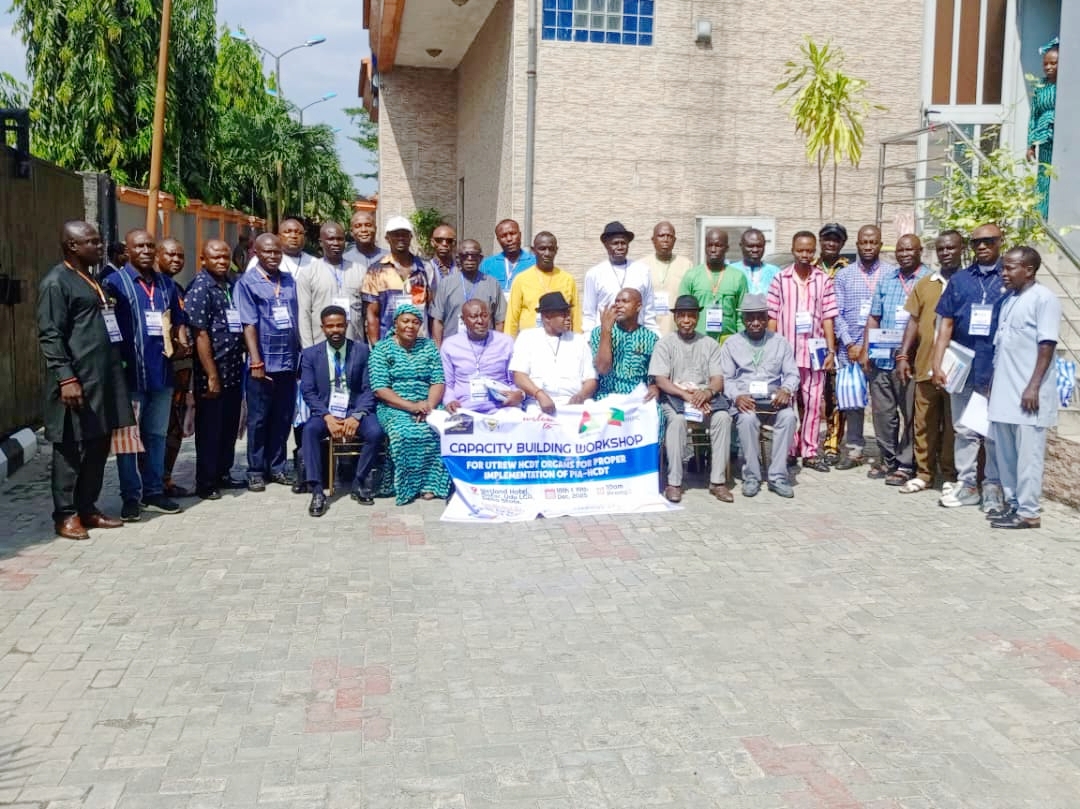
The National Coordinator of the Center for Peace and Environmental Justice (CEPEJ), Comrade (Chief) Sheriff Mulade, Ph.D, has called on host communities to fully gain understanding of the Petroleum Industry Act (PIA) that was enacted on August 16, 2021, stressing that its benefits can only be realized through proper interpretation, community awareness, and diligent implementation.
Mulade made the call at a two day capacity-building workshop, financed by the UTREW Host Communities Development Trust (HCDT) in the Udu Local Government Area, which commenced on Thursday, December 18, 2025, and drew participants from several oil-producing communities within OML 34.
The workshop was designed to deepen stakeholders’ understanding of the PIA, clarify the roles and responsibilities of key actors, and promote peaceful coexistence between host communities and oil and gas operators through effective governance of the Host Communities Development Trusts.
The workshop, which is also focused on effective implementation of the PIA and conflict resolution mechanisms, had community representatives drawn from Otor-Udu, Eruemukowharien, Okpare-Olomu, Uvwiamuge, Ekakpamre, Effurun-Otor, Umolo-Olomu, Ekrejegbe, Iwhrekan, Edjophe, Oghior, Owhrode, Agbowhiame, Otu-Jeremi, Eyara, among others.
Day one of the workshop ended with a collective call on Settlors (oil companies) for sustained engagement, regular capacity-building programmes, and stronger collaboration among host communities, regulators, and civil society organizations to ensure the PIA delivers tangible and lasting development in oil-producing areas.
Day two focused on conflict resolution in oil and gas host communities, with emphasis on Alternative Dispute Resolution (ADR) mechanisms and the role of HCDTs in preventing and managing disputes. The sessions underscored the need for dialogue, inclusiveness, and institutional processes to foster peaceful coexistence and uninterrupted petroleum operations.
Addressing participants at the workshop, the CEPEJ Boss who described the Act as "a landmark reform in Nigeria’s oil and gas sector", explained that funds accruing from the PIA are statutory and strictly meant for host community's development. He warned against diversion of such funds for personal interests, and stressed that "all monies released by oil companies to HCDTs must be applied to visible, impactful, and sustainable projects".
Mulade further advised Boards of Trustees to adopt inclusive leadership, work closely with community stakeholders, establish functional monitoring teams, and uphold transparency, accountability, and unity of purpose in project execution.
During the interactive session, participants express their concerns on the perceived challenges of PIA implementation at the grassroots, particularly the benefit-sharing matrix among host communities, describing it as contentious and a recurring source of tension in some areas.
A financial consultant, Mr. Tolu Oyero, stressed the importance of proper record-keeping by HCDTs, saying that accurate documentation is essential for accountability, auditing, and effective financial management of trust funds.
Chairman of the Board of Trustees of UTREW HCDT, Col. Morris Okoro Ideh Rtd, commended CEPEJ for facilitating the programme and urged participants to effectively apply the knowledge gained.
He specifically encouraged members to study Chapter Three of the PIA, which outlines the rights and obligations of HCDTs, noting that unity among trustees would compel Settlors to fully discharge their responsibilities to host communities.
Ideh also emphasized the need for Settlors to comply with the PIA, particularly in fulfilling their financial obligations to HCDTs and sponsoring training and capacity-building initiatives, describing such commitments as "the surest path to ending confrontations in host communities" while he called on members to study the PIA to address Internal issues, and for communities and settlors to "engage constructively, especially on the issue of the benefit-sharing matrix,” he stated.
A BoT member, Mr. Otega Orhokpocha Shadrach, affirmed that the training had equipped participants with practical knowledge on dispute resolution and the root causes of conflicts, and further explained that disagreements often arise from the existence of two different benefit-sharing matrices—one introduced by the Settlor and another traditionally used by host communities—each based on different formulas and production considerations.
He commended CEPEJ for the initiative, but however noted that the two-day training was constrained by limited resources as he called on the Settlor operating OML 34—the Nigerian Petroleum Development Company Limited (NPDC) in joint venture with ND Western Limited—to sponsor and fund regular training programmes as envisaged under the PIA.
He argued that aspects of the PIA require review to better protect host community interests, noting that while penalties exist for non-compliance by Settlors, such sanctions do not adequately compensate or benefit the affected communities.
The workshop ended with renewed commitment by stakeholders to apply the principles of the PIA, strengthen governance of the UTREW HCDT, and pursue peaceful, development-driven engagement in OML 34 host communities, with highlights of the closing session comprised the presentation of Awards and Certificates to the participants.
#penglobalcommunity #OML34 #PIA #CEPEJ #Delta